

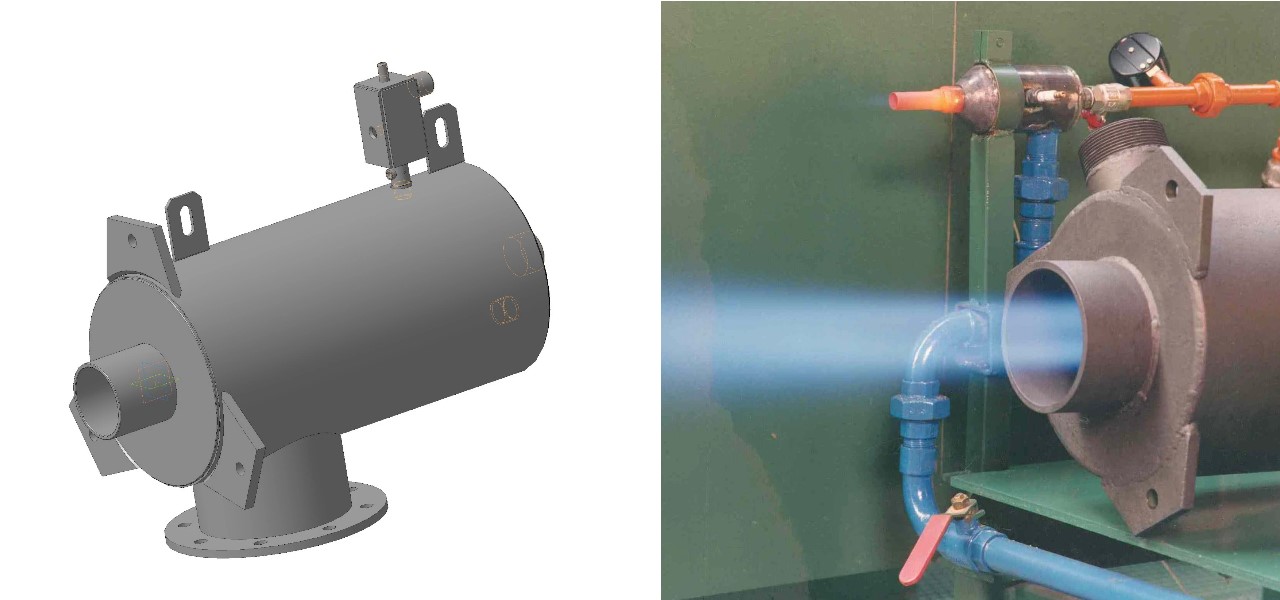
Tornado combustion
Tornado gaseous fuel reactor is a completely new combustion system, which generates a new type of flame that points out high combustion and heat transfer efficiencies.
The Tornado Reactor
Tornado reactor is a staged combustor that provides the proper conditions for gaseous fuels and oxygen to react fully while inhibiting the formation of thermal NO2.
The reactor consists of a cylindrical combustion chamber, a subsonic isentropic nozzle, two annular air chambers (concentrically with the combustion chamber), a gas injector and a ignition system (pilot).
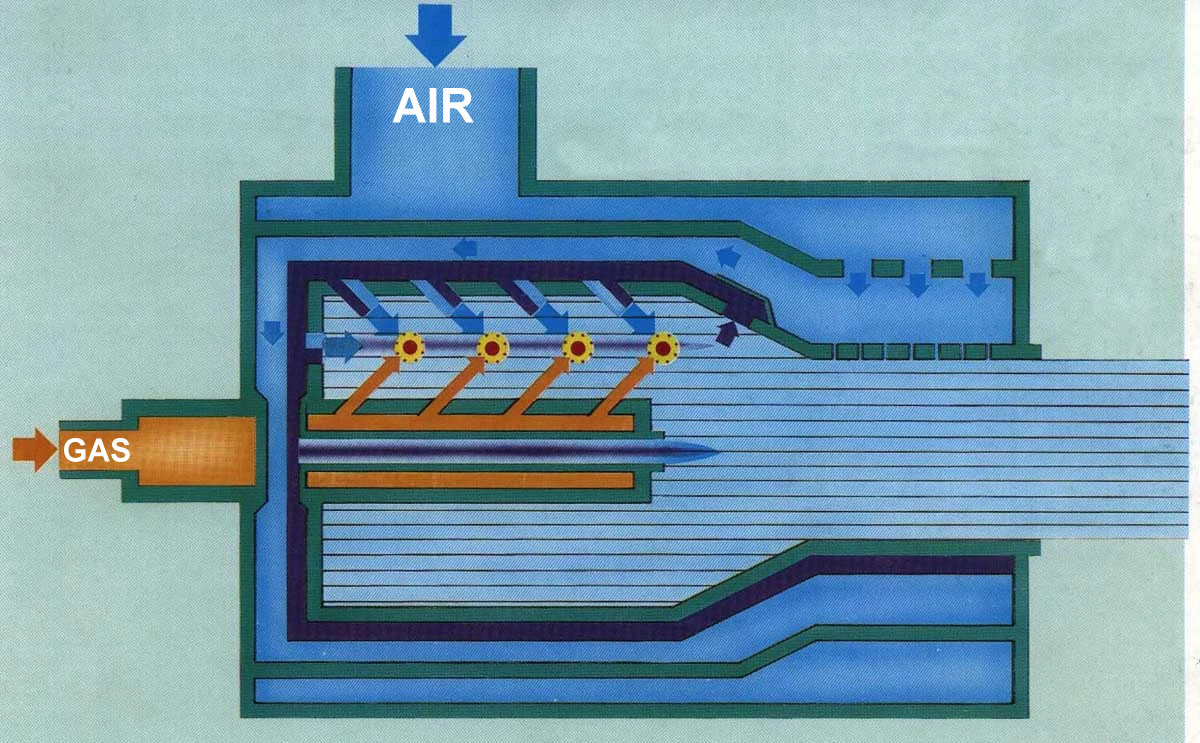
The fuel enters the combustion chamber via an annular tube gas injector inserted at the centerline of the combustion chamber and extended inside the combustion chamber for the entire chamber length.
The gaseous fuel flows inside the annulus while the inner tube allows a stream of air (or oxygen) to reach the last stage of combustion (end of combustion chamber). The outer tube of the reactor is provided with a multitude of drilled orifices displaced on several rows along its entire length. Longitudinally, these gas (fuel) orifices are in line and normally equally spaced.
The main air (or oxygen) enters the combustion chamber through a multitude of orifices drilled on the combustor chamber cylinder and on the back plate of the chamber. The number of gas orifices equals the number of air orifices drilled on the chamber wall and the center lines of corresponding gas orifices rows and air orifices rows are in the same geometrical plane.
The air flaws aim in an angle at the corresponding gas flaws. The circles formed by the points of impingement of the gas and air flaws form a combustion zones (stage). The number of stages (zones) is equal to the number of gas orifices of a single (in line) row or with the number of circles formed by the fuel-air (oxygen) impinging points.
The back plate of the combustion chamber is provided with o number of orifices equal to the number of gas/air (oxygen) impinging points of one stage. These orifices (drilled in the chamber back plate) discharge air streams parallel with the reactor center line and they aim at the first time in line impinging points of the gas and air flaws (first zone). These air flow streams (discharged from the back plate orifices) help to correct the direction of the resultant vectors of the gas/air impinging streams. Their momentums are such as to ensure resultant flows of reacting of reacting mixtures parallel with the centerline of the reactor.
The conical portion of the nozzle is provided with a multitude of gas passages that allow the products of combustion to enter the secondary air chamber.
The counter – flow air stream generates a venture effect at these passages high enough to allow some 17% to 20% of the products of combustion gases to mix with the incoming combustion air and thus to be recycled through the combustion chamber via all air orifices.
The free energies of the controlled thermodynamic reactions are released in stages and each stage is cooled or inhibited such as at no locations stoichiometric temperature can exist.
The gas temperature inside the combustion chamber and in the nozzle is under 1 6500C (2 9500F) for all standard reactors. There is no friction between the combustion gases flow and chamber walls or the straight tubular segment of subsonic discharge nozzle.
In order to reduce the critical temperature to the value of the chamber temperature the cylindrical portion of the nozzle is air film cooled.
Even the system is perfectly isentropic there is some heat transfer to the chamber and nozzle due to radiation. The incoming combustion air and fuel mostly remove this radiant heat. Thus the system becomes almost perfectly adiabatic. With cold combustion air the body of the reactor is at all times at room temperature. The combustion jet is transparent white and blue colored for the standard reactors and no visible for special designs.
The standard jet velocity is 167m/sec (550Ft/sec) for a chamber static pressure of 35mBar. The discharged flame has a cylindrical shape. The combustion jet is 4 to 5 times longer than of any other combustor operating at same injection pressures. Custom – designed reactors (for special applications) can provide other flame speeds and flame geometries.
The ignition for standard chamber is provided by a miniature reactor, a continuous or intermittent pilot. Other chambers are ignited by a spark plug or other type of igniter. The system is based on constant air and the standard net heat release turn down ratio is 40:1 (for medium and high heating value fuels) (with the same reactor one can dry her or his hair or forge steel).
The combustion efficiency is in the vicinity of 100% at all firing rates. The reactor can be recycled an average of 40% of the flue gas through specially designed nozzles (several patented designs are standard) or if can recycled process gases without or with the use of external energy (depending of the mass value). The standard reactor designs are for natural gas and propane fuel.
For cold air and fuel operations the reactor is made out of American standard alloys RA304 and RA310, and carbon steel (no refractories). For preheated air operations some components are made out of RA330 or Inconel601.
The reactors are easy to install and they are maintenance free. Because of its long cylindrical and smooth flame that does not touch the nozzle or a long narrow passage, the reactor can be located away from the furnace wall thus preventing the exposure of the device to the radiant heat of the furnace. This gives also many advantages to the furnace designer as he can use large momentum flames inside small cross section furnaces.
The emissions are:
carbon monoxide none, NOx < 20p.p.m. (for natural gas defined as CH4) and sound level 62dB (atmospheric standard conditions at 180m/sec flame speed).
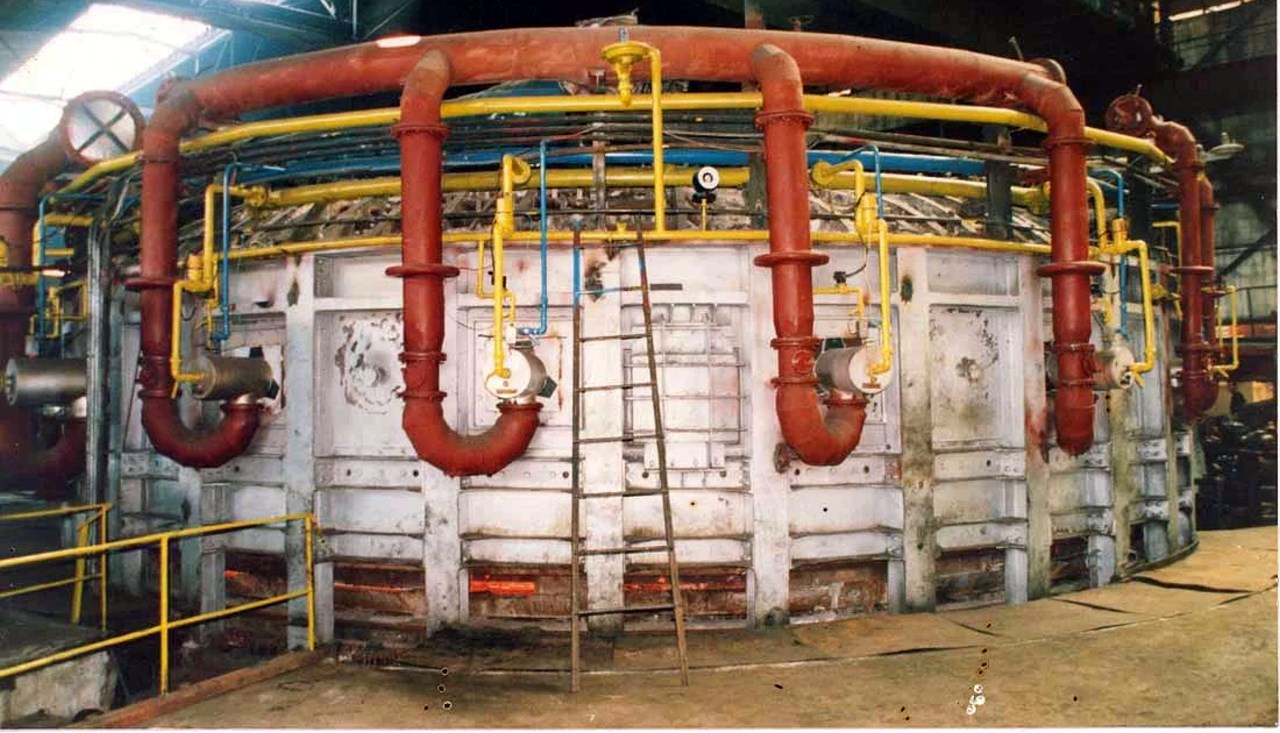
Applications:
a. Reheat and forge.
b. Heat treating.
c. Dryers and air heaters.
d. Non-ferrous melting.
e. Steel melting assistance (oxygen enriched air).
f. Incineration and pollution control.
g. High pressure, isentropic system combustion.
h. Residue and contaminated fuels burning.
i. Fire tube and radiant tubes heating.
Main characteristics:
- High combustion and heat transfer efficiencies;
- Long and uniform cross section flame;
- Very high velocity for low injection pressures;
- Under stoichiometric critical temperature and combustion products recirculation. No CO and very low NOx emissions;
- cold reactor body when operated with cold gases. Long life of the device and comfort for the operators;
- Preheating of the gases and flue gas recirculation by the use of its kinetic energy (several nozzle designs);
- 40:1 turn down ratio and very stable combustion at all firing rates. 4000% excess air capability with uniform temperature cross section flame;
- Instant ignition at any fuel input. Perfect device for PULSE FIRE and CONSTANT AIR system;
- Preheated combustion air standards (600degr.C max.);
- Constant or intermittent pilot operations;
- Accept the modern flame monitoring system (standard is P.C.I.).
Advantages
- Lower fuel consumption than any other combustion (or burner).
- Lower furnace refractory lining maintenance.
- Longer tube and extended surface life for process furnaces and metallic radiant heat applications.
- No burner block replacement.
- Highest flame safety due to its very high turn down ratio.
- Large operational pressures range (with jet velocity changes).
- High heat transfer rates due to its large discharged mass at high velocity (large excess air capability).
- Uniform and adjustable flame temperature.
- Rugged construction and easy to install.
- Cool body operation.
- Long life for any condition operation (in excess of ten years for clean fuels);
- Pay back in less than one year (when replacing a best conventional burner on the market).
The merits of the reactor Tornado
A. Safety
All reactors are provided with continuous pilot monitored by state of the art safety systems. The pilots are different than all the other pilots that usually cause problems to the furnace operators. These pilots are miniature reactors that ignite at the first push of the start button and maintain a perfect combustion jet that ignites the main gas all the time and at all settings. The reactor will ignite at all gas and air settings from 5% to 100% and pulse even on less than two second cycles. The low gas operating pressure (25-30 mBar) adds to the safety characteristics of the reactor.
B. Combustion
Measured by ISCIR Romania the reactor Tornado always showed carbon monoxide emission ZERO (CO = 0) while most of the conventional burners struggle at around 60% combustion efficiency (CE).The reactor shows always
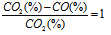
Actually the reactor CE = 99.99%
The Reactor Tornado can burn all types and kinds of fuel gases (low or high heating values) including pyrolysis gas from incineration. The reactor actually is a perfect small size incinerator. It will burn contaminated gases, wet gases and combustible powders in gases. It can dissociate more than 5% water and burn the hydrogen. In a most recent application the reactor is burning contaminated water containing HCN, polymers, sulphur compounds and organics. While the American made special burners pump out thousands of CO, NOx, ppm's as well as initial pollutants, the reactor maintains zero CO and NOx under 50 mg/Nm3.
The reactor can be provided with a venturi type secondary nozzle and it will recirculate flue gas (up to 40%) or furnace gas. On large systems the combustion air can be mixed with some 60% flue gas by the use of a Coanda accelerator (fluidics mechanics principle).
C. Scale reduction on steel reheat and forge
High temperatures and the long time in furnace (due to slow heating) create much and sticky scale on steel. Sometimes the scale can be so sticky that it cannot be removed thus a lot of rejects is formed. In most of the cases this material goes back to melting ... With the reactor heating the scale is always light (like cigarette ash) and non-sticky it drops out as soon as the part hits the press or hammer table. No rejects. Scale reduction occurs because of the continuous removal of the gas stationary film from all surface of the steel load.
D. Heat Transfer
In the direct-fired furnace applications the most valuable heat transfer method is convection. Not to use maximum convection in such a furnace is dumb. As we all know the radiant heat is transferred only when there is a temperature difference and when the receiver "sees" the source ... In the convection mode the heat is conveyed to the receiver by the furnace gases. The combustion product gases can reach all corners and hidden surfaces of the process load.
The higher the speed at the heat transfer surface, the higher will be the film coefficient, the convection coefficient. Not only that the stationary gas film is removed very rapidly from the load surface but the impact of high velocity gases on it increase the molecular vibrations, which in turn generate additional heat, thus increasing the conduction of heat through the load section.
The convection H.T. coefficient is a function of gas speed and higher at high gas speeds. (Hc = vx, x = 0.7 to 0.85 - surface shape factor).
A higher value of the convection coefficient means a higher overall HT coefficient, which in some furnaces might allow you to lower the pick temperature. The high-speed reactor jets stir the furnace chamber gas thus increasing its speed above the speed determined by the stack draft. Hot gases will be able to reach all surfaces of the load regardless of its shape.
The reactor flame jet temperature can be adjusted at 20ºF to 25ºF above the required process temperature and still do the job. Furnace temperature uniformity is a most important factor in metal heating and ceramics (refractory) heat treat. Actually the chrome and nickel alloys cannot be heated properly at high temperatures by radiation in furnaces where the burners create hot spots. These materials need high-speed gases to wipe their surfaces and uniform temperature all around and as low as possible (slightly above the set point) in order to gain uniform heating and avoid cracks due to thermal stresses.
E. Long life of the system
Besides the reactor, which does not need any repair or part replacement many other components of the furnace system will have their life increased. Due to lower temperature and uniform heating the refractory lining lasts two to three times longer. Recuperator tubes last years more, and do not need regular cleaning (no carbon deposits). No burner blocks replacements. Reactors and pilots have up to five (5) years guarantee.
F. Payback of Investment
Usually the payback calculated on 30% savings is under six months on medium size reactors
(5MM BTU/HR to 10MM BTU/HR). Smaller reactors might need nine to 12 months in order to recover the investment.. The reactor is a Cash Deposit in the bank and its life span is estimated at two decades.
G. Environmental Impact
The Reactor is "perfect combustion". Perfect combustion means at least the elimination of one pollutant, the carbon monoxide. Increasing the combustion efficiency means a reduction of CO2 also. Along with the NOx reduction this CO and CO2 reduction contribute to a better local environment and towards a lower rate of global temperature changes.